Teaching Strategies

The Center for Ecoliteracy promotes a variety of teaching strategies, based on practices matched to students' levels of development and on brain-based research, to foster the knowledge, skills, and values essential to sustainable living. We recognize that students learn best when teaching strategies are varied to include hands-on activities, time for reflection and thoughtful discussion, a mix of indoor and outdoor environments, and opportunities to participate in interdisciplinary projects.
Place-based Learning
Nearly a century ago, John Dewey called for experiential learning that engages students in their own environments.
An increasing number of teachers are embracing place-based learning as a strategy that captures students' imaginations and advances environmental stewardship and civic engagement.
Place-based learning begins with asking questions such as, "Where am I? What is the natural and social history of this place? How does this place fit into the larger world?"
Successful place-based programs involve students as participants in the life of their communities. Successful projects demonstrate many of the following characteristics:
- Learning takes students out of the classroom and into the community and natural environment
- Projects have consequences; students' contributions make a difference to environmental quality and to the well-being of communities
- Place-based projects are integrated back into classroom lessons
- Students want to learn in order to apply their knowledge to solving real problems
- Students play an active role in defining and shaping projects
- Students collaborate with local citizens, organizations, agencies, businesses, and government. Working alongside community members, students help make plans that shape the future of their social, physical, and economic environments
- Students are encouraged to view their community as an ecosystem and to understand the relationships and processes necessary to support healthy living
- By mapping their school and its surrounding community, students create visual representations of the systems nested within larger systems that constitute their local place in its wholeness
There is a growing body of research on the benefits of place-based learning. Among them: higher test scores, better grade-point averages, improved classroom behavior, increased self-esteem and problem-solving abilities, and higher-level thinking skills.
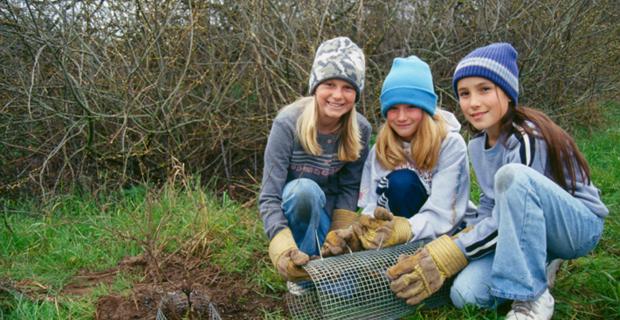
The Center for Ecoliteracy encourages place-based learning through activities such as mapping the local environment to learn key ecological and cultural principles, studying the interplay between local society and the environment, supporting habitat restoration projects, and working with local citizens to improve the quality of life in their communities.
Project-based Learning
While many teachers involve students in projects after exposing them to traditional instruction, project-based learning is not an extension or add-on but is central to the curriculum. Based on challenging questions requiring complex thinking and skills, project-based learning is often interdisciplinary.
Projects vary in length — from a couple of weeks to an entire school year — and require students to use a variety of resources, including the community, technology, outside experts, written resources, and the Web, as well as each other. Rather than being the "expert," the teacher acts as a facilitator to learning.
Research shows that project-based learning increases critical thinking skills and fosters positive attitudes toward subjects such as mathematics and superior performance with conceptual questions and applied problems.
Furthermore, elementary teachers who have used project-based learning identify several positive benefits, including better attitudes toward learning, better work habits, improved problem-solving capabilities, and more self-esteem.
The Center for Ecoliteracy has supported teachers in designing project-based learning experiences such as habitat restoration, modeling the evolution of agriculture, and changing the food in schools.
Socratic Inquiry
"Socratic inquiry" is named for the Greek philosopher Socrates, who believed that questions — not answers — stimulate learning.
Rather than teaching facts and information, Socrates encouraged young people to question their assumptions, values, and preconceptions.
Through this process, students uncover their beliefs, misconceptions, and values, and eventually clarify their thoughts related to the topic under discussion.
Through engaging in Socratic discussions, students can become more adept at critical thinking, improve their listening skills, learn to better articulate their thoughts and ideas, and become more tolerant of diverse opinions.
In Socratic inquiry, the role of the teacher shifts from direct instruction to facilitating discussion. Through skilled questioning, the teacher asks students to clarify their statements, identify weaknesses in their arguments, and provide evidence for their reasoning.
The Center for Ecoliteracy has developed curriculum grounded in Socratic inquiry, such as a teacher's guide for the highly publicized film Food, Inc. Through this curriculum, high school students discuss and debate issues such as animal welfare, workers' rights, the right to know what is in our food, and the copyrighting of genetically modified plants. By debating controversial issues, students come to a more sophisticated understanding of their complexities.
Experiential Learning
Grounded in the work of John Dewey and Jean Piaget, experiential learning recognizes that learning is an active process.
Traditional schooling views the teacher and text as experts and the learner as a passive recipient of that expertise. By contrast, experiential learning promotes involvement in the real world and defines the teacher's role as a facilitator of learning. The process of learning takes precedence over the behavioral outcomes, and is based on the premise that learning is a continuous process, with experience at its foundation.
When students participate in experiential learning, they frequently follow what is known as "the learning cycle." This is a process, based on constructivist theory, which starts with unstructured exploration, followed by what developmental theorists call concept formation and concept application.
For example, when studying decomposition using a worm bin, students start by examining a scoop of the bin's contents. After having time to explore, they identify questions to pursue (concept formation). They design and carry out further investigations and report their findings to the class (concept application). The cycle is repeated as students test ideas and refine or change their assumptions and understandings.
Experiential learning is vital to schooling for sustainability. Only through direct contact with the natural world will students develop an in-depth understanding of fundamental ecological principles. By working with others to solve real-world problems, they also develop skills at the heart of sustainable living.
The Center for Ecoliteracy promotes experiential learning through our emphasis on school gardens, food and cooking, civic engagement, and the schoolyard as a learning laboratory.
Interdisciplinary Learning
Interdisciplinary learning emphasizes connections between traditionally discrete disciplines such as math, science, history, and language arts, rather than limiting learning to one content area at a time.
When teaching and learning are organized around themes, problems, or issues, students seek knowledge and skills from a variety of disciplines to provide an expanded and more complex understanding of the topics they are studying.
When done well, interdisciplinary learning eliminates the fragmentation and the learning of isolated skills. It allows students to access a particular theme from different entry points as they work with a range of sources of information and perspectives; it also allows teachers to better differentiate instruction and create more interesting and rich methods of assessment.
Research has demonstrated that interdisciplinary teaching can increase students' motivation for learning as well as their level of active engagement. In contrast to learning skills in isolation, when students participate in interdisciplinary learning they recognize the value of what they are learning and become more involved in it.
Furthermore, studies show that students learn more when they apply a variety of skills to what they are studying and when they interact with their classmates, teachers, and members of the community.
The Center for Ecoliteracy advocates for interdisciplinary teaching and learning as the best approach for grasping the principles that help define sustainable living. Our publications, seminars, and ongoing work with schools take an interdisciplinary approach.