What Does It Mean to Be Ecoliterate?

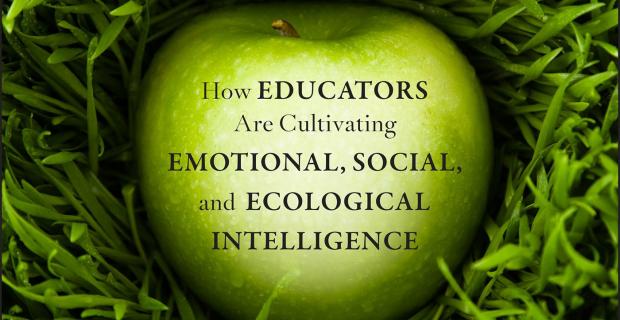
This essay is adapted from the Introduction to the Center for Ecoliteracy's latest book, Ecoliterate: How Educators Are Cultivating Emotional, Social and Ecological Intelligence, by Daniel Goleman, Lisa Bennett, and Zenobia Barlow (Jossey-Bass, August 2012).
Ecoliterate tells inspiring stories of pioneering educators, students, and community leaders engaged in issues related to food, water, oil, and coal in communities from the mountains of Appalachia to a small village in the Arctic; the deserts of New Mexico to the coast of New Orleans; and the streets of Oakland, California to the hills of South Carolina.
These stories illuminate what a growing number of educators have begun to identify as a deeply felt imperative: to support learning that genuinely prepares young people for the ecological challenges presented by this entirely unprecedented time in human history.
Ecoliterate enables educators to foster the kind of learning that meets the critical needs of the twenty-first century — and offers an antidote to the fear, anger, and hopelessness that can result from inaction. It reveals how the very act of engaging in some of today’s great ecological challenges — on whatever scale is possible or appropriate — develops strength, hope, and resiliency in young people. And it presents a model of education for doing so that is founded on a new integration of emotional, social, and ecological intelligence.
From Emotional to Ecological Intelligence
The model of education presented in Ecoliterate takes the cultivation of emotional and social intelligence as its foundation and expands this foundation to integrate ecological intelligence. But rather than conceive of these as three separate types of intelligences, we recognize emotional, social, and ecological intelligence as essential dimensions of our universal human intelligence that simply expand outward in their focus: from self, to others, to all living systems. We also conceive of these intelligences in a dynamic relationship with each other: Cultivate one, and you help cultivate the others.
The practice can take many forms. But we identify two core dimensions as through-lines. One is affective, or related to emotions: namely, empathy for all forms of life. By "empathy," the ability to understand and share the feelings of another, we do not intend to imply that plants, for instance, have feelings. Rather, our intent is to encourage a sense of caring that is not restricted to other human beings but extends to all forms of life.
The other through-line is cognitive, or related to how we think: that is, understanding how nature sustains life. Since life began, Earth’s ecosystems have developed ways of supporting the great web of human and nonhuman life through certain patterns and processes, such as cycles, networks, and nested systems — all of which reflect the fundamental fact, as Center for Ecoliteracy cofounder Fritjof Capra puts it, that "nature sustains life by creating and nurturing communities." To understand how nature sustains life, then, requires the capacity for systems thinking, or the ability to perceive how the different aspects of a living system exist, both in relationship to one another and relative to the whole that is greater than its parts.
But how, it would be reasonable to ask, can anyone truly develop the capacity to understand all the ways in which human systems interact with natural systems and act upon that knowledge? The answer is simple: We can’t. Not alone.
Rather than residing within a single individual, ecological intelligence is inherently collective. Socially and emotionally engaged ecoliteracy, therefore, encourages us to gather and share information collectively, and to collectively take action to foster sustainable living. This makes school communities — which, like ecosystems, come to life through networks of relationships — ideal places to nurture this new and essential ecological sensibility.
Educational and Ecological Benefits
Many schools embraced social and emotional learning during the past several decades on the promise that helping children develop the capacities for self awareness, self management, social awareness, and relationship management would increase their likelihood of success in school and in life.
Now, extensive research shows that these programs do lead to important student gains and reduced risks for failure. For example, a 2011 meta-analysis by the Collaborative for Academic, Social, and Emotional Learning of 213 social and emotional learning programs concluded that these programs improve students’ achievement test scores by 11 percentile points — and lead to even greater gains in improved attitudes and positive classroom behaviors, as well as reductions in conduct problems and disciplinary actions.
Research studies examining the influence of an environment-based context have revealed similar encouraging findings with respect to academic performance. In the two decades that the Center for Ecoliteracy has worked with schools to support education for sustainable living, it has found that socially and emotionally engaged ecoliteracy advances both teacher and student involvement and achievement through hands-on, experiential, contextual learning in the natural world and community.
The cultivation of emotional, social, and ecological intelligence, as a result, builds on the successes resulting from the movement in education to foster social and emotional learning — and it cultivates the knowledge, empathy, and action required for practicing sustainable living.
Excerpted with permission of the publisher, Jossey-Bass, a Wiley imprint. From Ecoliterate: How Educators Are Cultivating Emotional, Social and Ecological Intelligence, by Daniel Goleman, Lisa Bennett, and Zenobia Barlow. Copyright © 2012 by Center for Ecoliteracy.